| Lesson 4
|

| Lesson 4
|
 Make sure you go through the new Arabic Language Frequently Asked Questions section (FAQs). It has a growing list of common questions selected from hundreds of visitors and students of Arabic language.
|
| Check out my Recommended Arabic Language Resources. I reviewed these BOOKS, SOFTWARE or HARDWARE. Click on any of the rotating images below for more details: |
 |
 |
 |
 |
 |
|
|
|
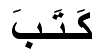
write |
books |
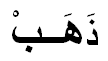
gold |
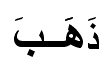
went |
 |
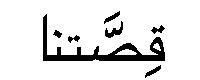 |
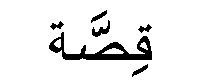
 I know that this is confusing but I just wanted to give you an idea about the "Ta' Marboota" to understand its concept for a start.
 | The letters | Pronunciation |
 |
AN |
 |
BON |
 |
TIN |
|
|
Note: Use this Arabic language dictionary as a learning aid:
|
| Search Arabic Language Resources: |
|
|||||||
|
. HOW TO MAKE THE MOST OUT OF THIS ARABIC LANGUAGE COURSE? Do you hate huge paper dictionaries as much as I hate them? While learning Arabic or if you are traveling to an Arab country, I highly recommend getting an Arabic language electronic dictionary. I spent some time browsing the Internet looking for a good one. I ended up choosing the Language Teacher by ECTACO.
I was really startled by the value! They make dictionaries in more than 20 languages (including Arabic) and in various price categories. I recommend these dictionaries to anyone who intend traveling to Arab countries or wants to learn Arabic on the move. They also make great gifts!
You can familiarize yourself with such dictionaries here. Make your time learning Arabic easier - you have no idea how much help you can get from a tiny handheld device. I guarantee you'll be as amazed as I was.
|
| If you liked this tutorial and thought that it helped you, then feel free to add a link to this tutorial from your website and share it with other people.
|